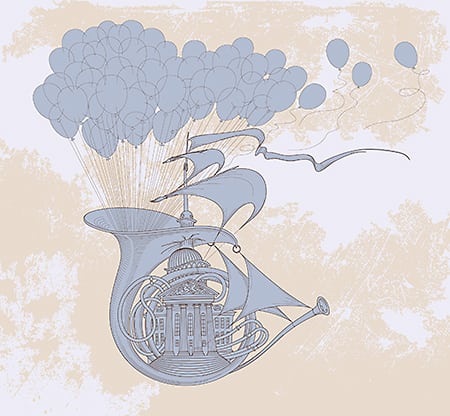

This event will include a conversation between guest editors Jeanne Gang and Lizabeth Cohen and architects and GSD alumni Lap Chi Kwong and Alison Von Glinow, cofounders of Kwong Von Glinow. Kwong Von Glinow’s design proposal for a renovation of a pavilion located on Chicago’s downtown lakefront is featured in this issue of the magazine and will debut at this year’s Chicago Architecture Biennial.
About the Issue:
Put the city up; tear the city down, put it up again; let us find a city. —Carl Sandburg, “The Windy City,” 1922
Chicago was a well-loved subject of writer Carl Sandburg. His poems vividly recount the people who labored to make and remake the city during its heady period of growth in the 1910s and 1920s. Chicago’s cycle of construction and demolition stemmed from burgeoning housing and commercial demand, as well as ongoing civic improvements. But it was accelerated by architectural obsolescence, a real estate concept born in New York that reached a fever pitch in Chicago. New federal taxes incentivized owners to demolish “obsolete” buildings as young as 13 years old and replace them with more up-to-date structures. Witnessing this watershed change, Sandburg characterized the city as a place where buildings went up and down as naturally as the sun.
One hundred years later, Sandburg’s appeal to “let us find a city” feels as urgent as ever. There are grave environmental consequences of the construction-demolition cycle that once seemed full of promise. As we work to reduce the industry’s outsized contribution to the climate crisis, how can we simultaneously ensure our cities stay alive and responsive to their inhabitants? How can we live more lightly on the earth?
Reuse and repair offer one potent path forward. They save between 50 and 75 percent of embodied carbon emissions compared to new construction. Governments and institutions increasingly recognize this significance and are enacting incentives and regulations to encourage reuse and curb the building industry’s carbon pollution. Yet the architectural profession—as well as the schools that populate its ranks—continue to promote the notion that creating new buildings is the most valuable form of architectural expression. Architects who design formally distinctive buildings from scratch have long been rewarded with more lucrative commissions and accolades. Still, interest within the architecture and planning fields about the reuse, repair, and reinvention of what already exists is growing.
This issue of Harvard Design Magazine seeks to develop this increasingly vital movement, engaging reuse across multiple scales—from individual buildings to downtown streets and the regulatory frameworks that organize our cities. Highlighting creative and interdisciplinary thinking, the issue promotes the act of bringing new life to what already exists as a powerful brief for designers, their clients, and the communities they serve. We bring designers and planners together with mayors, educators, artists, and scholars from fields including urban and architectural history, disability studies, sociology, and ethnography. And we aim to open a conversation about how designing toward a low-carbon future can go hand in hand with the wider work of caring for and remaking our cities and society.
Reuse has long challenged strict notions of architectural authorship, exposing how design is often an asynchronous and collaborative process involving different architects, inhabitants, and many other stakeholders over time. Compelling cases of reuse also show that the most lasting buildings are often those most open to change.
As resistance to viewing the reuse and repair of buildings as a legitimate form of design wanes, the appeal at the heart of Sandburg’s poem—“let us find a city”—is hopefully capturing the attention of future generations. This issue asks: If we free ourselves from the inherited limits on design practice, what new kinds of architecture, cities, and ways of being might we create?
00:00 Welcome by Sarah Whiting
05:28 Introduction by Ken Stewart
13:21 Presentation by Lizabeth Cohen
23:36 Presentation by Daniel Abramson
32:41 Presentation by Jeanne Gang
43:41 Presentation by Lap Chi Kwong and Alison Von Glinow
54:26 Panel Discussion
01:11:05 Q+A
source
UCcA1don221rKq1EmbvQB27g